

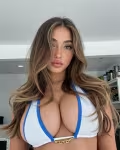
Selena Gray has been described in the existing Viral Model Hub article as a virtual or AI-related Instagram profile associated with @selenagrayxo. The account currently returns a restricted-profile page, and the operator, production method, and public history could not be independently confirmed during this review.
That matters because a polished social-media image does not, by itself, prove that a person is fictional, that an image was generated with AI, or that a particular software platform was used. The most accurate description at present is that Selena Gray was presented online as a virtual-model profile, while several important details remain unconfirmed.
The Instagram account cited in the earlier article

The previous article identified @selenagrayxo as Selena Gray’s Instagram handle. When checked for this update, the URL returned a restricted-profile page rather than a readable public biography, archive, or creator disclosure.
A restricted or unavailable profile is difficult to verify. An account may be private, renamed, deleted, limited by the platform, or no longer controlled by the person or team that originally used the handle. Search results can also preserve old descriptions after the underlying page has changed.
For that reason, the handle is best treated as a lead rather than proof of a complete identity. The available public evidence did not establish who operates the account, whether the name Selena Gray refers to a fictional character or a real creator, or whether the profile is currently active.
What the previous article claimed
The earlier article described Selena Gray as a virtual influencer whose fashion and lifestyle content blurred the boundary between reality and digital creation. It also suggested that the persona was produced with a combination of 3D modeling, animation, and artificial intelligence, and named tools such as Unreal Engine and MetaHuman.
Those technologies are used in digital-human and virtual-production projects, but mentioning them in a general explanation does not prove that they were used for this particular profile. No accessible primary source was found during this review that connected Selena Gray to a named creator, studio, agency, software pipeline, campaign, or interview.
The previous article also referred to a growing follower base, interactive content, promotional material, and the appeal of virtual influencers to brands. Without dated account data, campaign pages, or reporting from a reliable source, those Selena-specific claims should not be repeated as confirmed facts.
What remains unconfirmed?
The following points remain open:
- Whether Selena Gray is entirely AI-generated, CGI, AI-assisted, or connected to a real model.
- Who operates or created the account.
- Whether Selena Gray is a fictional persona or a real creator identity.
- Which tools, if any, were used to make the images or videos.
- The account’s current follower count, engagement, or posting activity.
- Any brand partnerships, paid campaigns, affiliate relationships, or agency representation.
- Whether the same handle is controlled by the original operator across different platforms.
This does not prove that the earlier claims are false. It means the public record reviewed here is not strong enough to publish them as established biography.
Why visual clues are not enough to prove an AI profile
People often point to perfect skin, unusual hands, inconsistent text, unrealistic lighting, or a highly polished background when they suspect that an image was generated with AI. These clues can justify further checking, but they are not conclusive. Photographers, retouchers, 3D artists, and image-editing tools can create similar effects.
The reverse is also true: a realistic image does not prove that it came from a camera. A profile can combine photography, CGI, generative AI, retouching, stock assets, and human-written captions. The production method may vary from post to post.
The strongest evidence usually comes from a current disclosure, a named operator, a studio or agency statement, a dated interview, a campaign page, or a platform label that explains why content was identified as AI-related.
How to verify a virtual-model profile
Readers investigating Selena Gray or another digital-model account can use a few practical checks.
Start with the account itself
Read the current biography, pinned posts, highlights, linked website, and contact information. Look for language that identifies the persona as virtual, fictional, CGI, or AI-assisted. A disclosure should be dated and connected to the account being examined.
Look for the operator
A credible profile may identify a photographer, artist, studio, agency, or brand. If an account claims to be a major project but does not identify anyone responsible for it, that gap should be reflected in the article rather than filled with assumptions.
Compare outside sources
Search for dated interviews, campaign pages, portfolios, and established publications. Check whether they describe the same handle, character name, operator, and production method. Do not treat copied biographies, scraped pages, or unattributed social posts as independent confirmation.
Use reverse-image search carefully
A reverse-image search may reveal that an image appeared earlier in a photographer’s portfolio, a brand campaign, a stock library, or another account. A result can help identify the source of an image, but a lack of results does not prove that an image was generated with AI.
Treat platform labels as context
Meta says its AI information labels may be based on industry-shared technical signals or on a person disclosing that content was made with AI. A label can provide useful context, but labels and detection systems can change, and the absence of a label is not proof that an account is human-made.
For a fuller checklist, see Viral Model Hub’s guide on how to tell if an Instagram model is AI-generated.
Virtual influencers are a wider digital-media trend
Virtual influencers are not a new idea. BBC reporting on profiles such as Shudu and Lil Miquela documented how digital characters can attract audiences, appear in fashion contexts, and create uncertainty about who is speaking behind an account.
That broader history helps explain why a profile such as Selena Gray may attract attention. A digital persona can maintain a consistent visual style, appear in different settings, and be managed by a real person or team. The character may be fictional even though the creative work, business activity, and audience relationships behind it are real.
The key editorial distinction is between the persona, the images, and the operator. A reader can appreciate a digital character’s visual concept without being told that unverified background details are confirmed biography. The updated Stellerbabetv transparent profile applies the same evidence-first approach.
Final assessment
Selena Gray should currently be described as a profile previously presented as a virtual or AI-related model associated with @selenagrayxo. The account’s current status, operator, production method, audience history, and commercial relationships could not be independently confirmed during this review.
That conclusion is more limited than calling Selena Gray a documented AI-generated influencer, but it is more accurate. If the account or its operator later publishes a clear statement, this article can be updated with a dated account status, verified creator information, production details, and documented partnerships.
Editorial note
This article was reviewed on October 9, 2026. The earlier Viral Model Hub article, the cited Instagram handle, public search results, Meta’s AI-label guidance, and established reporting on virtual influencers were reviewed. Because the cited profile currently returns restricted-account information and no reliable independent source confirmed the Selena-specific claims, uncertain details are identified rather than presented as fact.
Sources reviewed
- Selena Gray’s cited Instagram profile — currently returns a restricted-profile page; insufficient public information was available to verify the original claims.
- Meta: Our approach to labeling AI-generated content and manipulated media — explains AI information labels, self-disclosure, and industry signals.
- BBC: The fascinating world of Instagram’s “virtual” celebrities — provides broader context on virtual characters and their operators.
- Viral Model Hub: How to Tell If an Instagram Model Is AI-Generated — practical guidance on separating evidence about images, personas, and operators.


