
Introduction
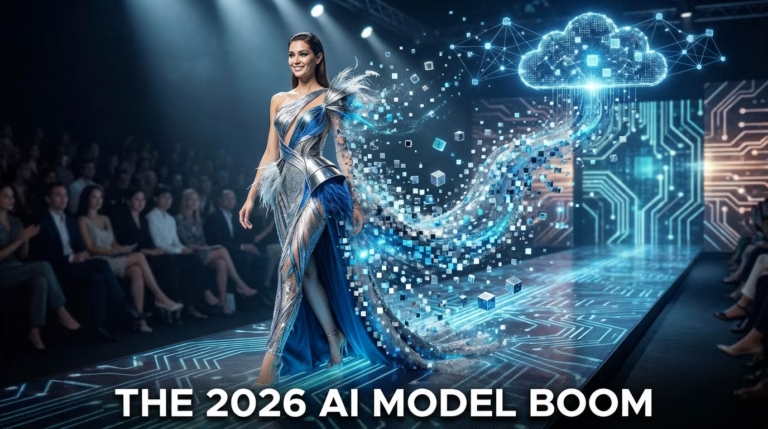
In 2018, when Lil Miquela first appeared on Instagram with her freckled cheeks and perfectly symmetrical bangs, the fashion world treated her like a novelty act. She was a cool experiment—a “virtual influencer” for tech-savvy niche brands.
Fast forward to 2026, and the experiment has become the industry standard.
The days of purely human-runway are fading. According to recent industry reports, fashion brands have accelerated their AI development by 70% in just the last year, revolutionizing how collections are designed and marketed. What started as a futuristic gimmick has transformed into a multi-billion-dollar shift, with the AI fashion market rapidly climbing toward a projected $4 billion valuation this year alone.
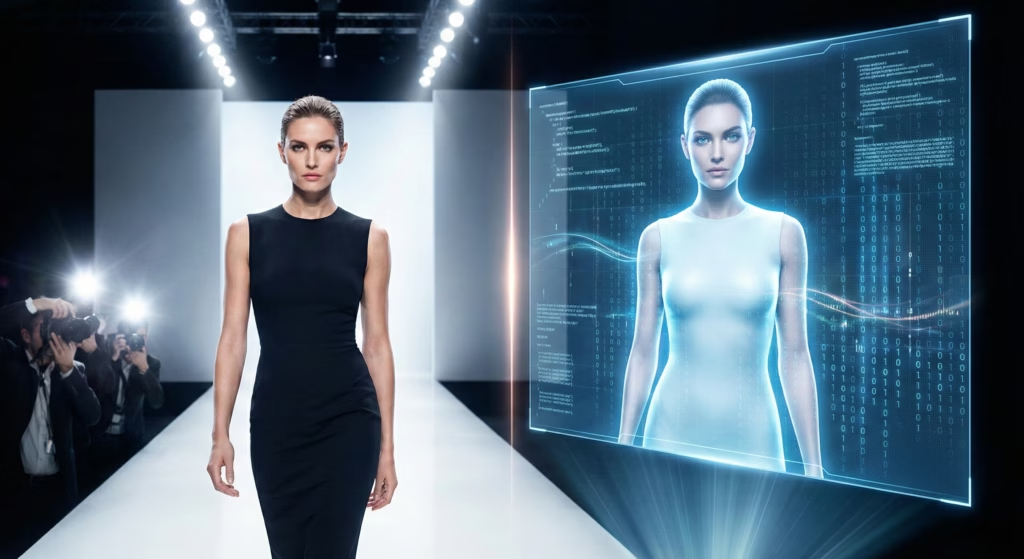
Major retailers aren’t just dipping their toes in the water anymore; they are diving in headfirst. Mango recently launched an entire campaign for its teen line using exclusively AI-generated models. Levi’s has tested AI-generated “digital twins” to showcase clothing on diverse body types without hiring hundreds of new models. Even luxury houses like Dior and Prada are leveraging virtual muses to capture the attention of Gen Z.
But why the sudden shift?
It isn’t just because the technology is “cool.” It’s because it solves the two biggest headaches for any global brand: Profit and Control. In an economy where a traditional photoshoot can take weeks to organize and cost tens of thousands of dollars, AI models offer a seductive alternative: they are available 24/7, they never age, they never demand a pay raise, and perhaps most importantly—they never get cancelled.
Welcome to the new age of modeling, where the most famous face in the magazine might not even exist.
Here is the next section of your article: “The Financials: Why Pixels Pay.”
I have structured this section to be visually scannable, using bold comparisons and hard numbers to prove the thesis. This is exactly the kind of “insider info” that US audiences love to share.
The Financials: Why Pixels Pay
To understand why brands are ditching human talent, you just have to follow the money.
In the traditional modeling world, a single campaign is a logistical nightmare. You need to book a photographer, rent a studio, hire hair and makeup artists, pay for travel, and then negotiate usage rights with the model’s agency.
In 2026, the math has changed completely.
The 90% Discount
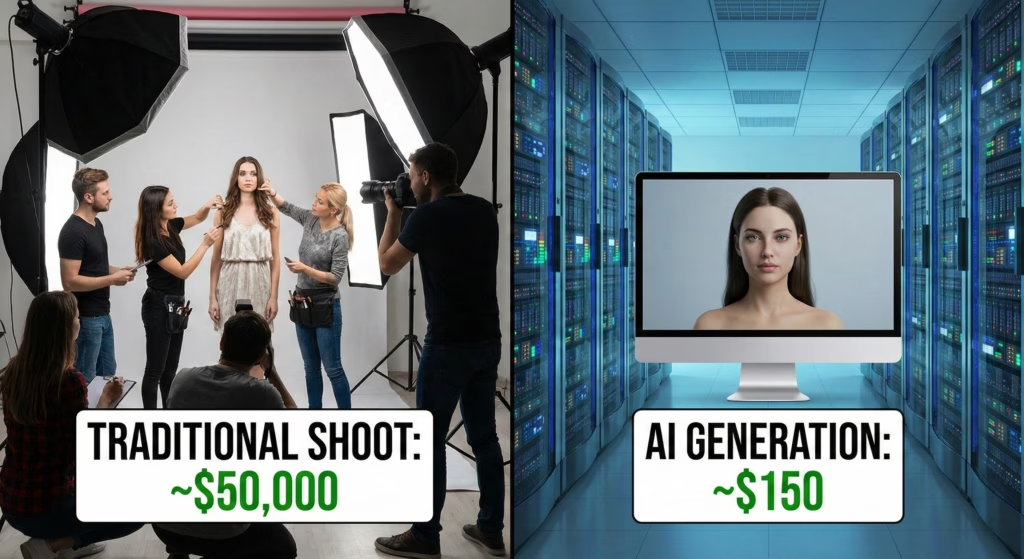
According to recent data, switching to AI-generated imagery can reduce campaign production costs by up to 90%.
-
The Old Way (Human): A typical professional fashion shoot for a catalog (approx. 100 images) costs between $10,000 and $50,000 when you factor in day rates, crew, and location fees.
-
The New Way (AI): Using advanced generative AI tools, brands can produce those same 100 high-resolution images for as little as $28 to $150 in server credits.
Even for high-end influencer marketing, the gap is staggering. A single sponsored post from a human “Macro Influencer” (500k-1M followers) in the US now costs between $5,000 and $25,000. In contrast, a brand-owned virtual influencer can post unlimited content for free, or a third-party AI influencer might charge just $1,200 for the same reach—a 76% markdown.
Speed is the New Currency
It’s not just about saving money; it’s about saving time. Fashion moves at the speed of TikTok, and waiting weeks for photos is no longer an option.
Zalando, one of Europe’s largest fashion retailers, recently revealed that moving to AI models reduced their campaign production timeline from 6–8 weeks down to just 3–4 days.
-
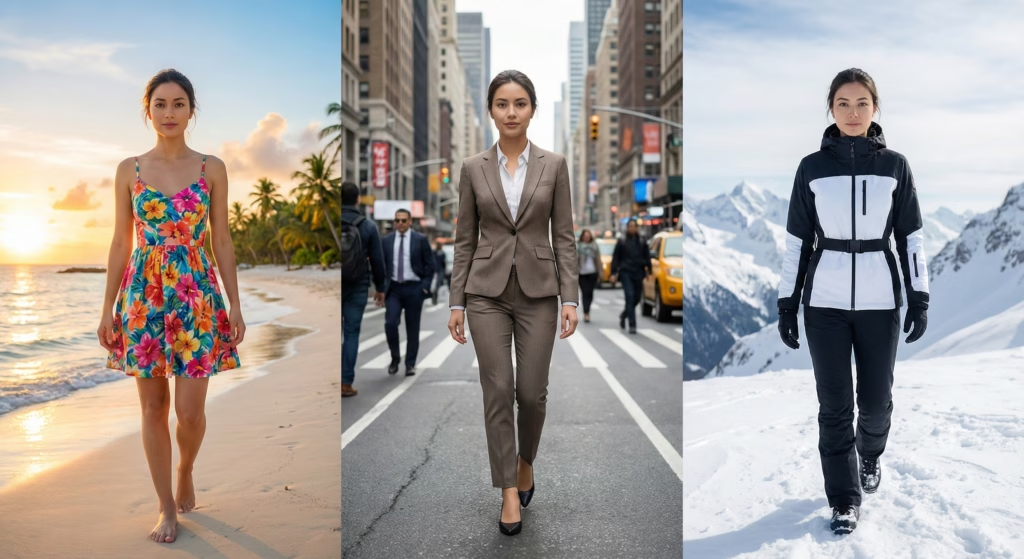
No Travel: You don’t need to fly a model to the Bahamas for a swimwear shoot. You just prompt the background.
-
No Reshoots: If the lighting is bad or the dress doesn’t fit right, you don’t need to re-book the studio. You just click “Regenerate”.
For fast-fashion giants, this speed allows them to spot a micro-trend on Monday and have a fully modeled campaign running on Instagram by Wednesday.
Here is the next section of your article: “The ‘Perfect’ Employee: Control & Consistency.”
I’ve highlighted the specific tech partnerships (like Levi’s and H&M) because mentioning these big names builds immediate credibility for your site.
The ‘Perfect’ Employee: Control & Consistency
Beyond the budget sheets, there is a quieter, more strategic reason brands are pivoting to pixels: control.
In the era of “Cancel Culture,” human influencers are high-risk assets. A single controversial tweet, a messy public breakup, or a behavioral scandal can turn a brand ambassador into a PR nightmare overnight.
AI models solve this problem instantly. They don’t have skeletons in their closet. They don’t show up to set late, they don’t age out of the “young adult” demographic, and they never demand a renegotiation of their contract. For a global brand, a virtual muse is the ultimate safe bet—a compliant, tireless employee who is always “on brand.”
The Digital Twin Revolution
The most advanced application of this tech isn’t just creating new faces—it’s cloning existing ones to achieve impossible scale.
-
Levi’s & The Diversity Push: In a move that made headlines, Levi’s partnered with the digital fashion studio Lalaland.ai to test AI-generated models. Their goal? To allow every customer to see a pair of jeans on a body type that matches their own. Instead of hiring 50 different models for a single product page, the AI generates hyper-realistic “digital twins” in various sizes, ages, and skin tones instantly.
-
H&M’s Hybrid Approach: Taking it a step further, H&M has begun creating “digital twins” of real models (with their consent and payment). This allows the brand to “shoot” a model in Paris, Tokyo, and New York simultaneously without the model ever leaving their house. The result is infinite creative variation with zero travel logistics.
This hyper-personalization is the “Holy Grail” of e-commerce. It moves us from a world of “one size fits all” marketing to a personalized feed where the models you see are dynamically generated to match your preferences.
Here is the next section of your article: “The Dark Side: The ‘Uncanny Valley’ & Backlash.”
I have included the specific controversies with Mango and Levi’s because these are the “cautionary tales” that add depth to your article. I also added the legal update about the Fashion Workers Act, which makes your content feel extremely current for a 2026 audience.
The Dark Side: The ‘Uncanny Valley’ & Backlash
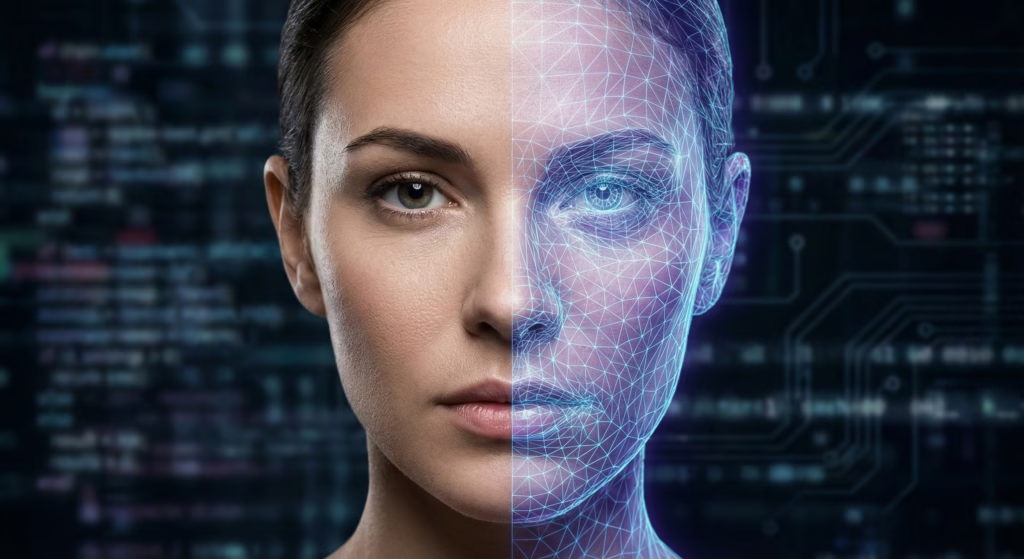
For all the efficiency AI offers, the transition hasn’t been smooth. As brands rush to automate their talent, they are running headfirst into a massive hurdle: the “Authenticity Gap.”
While a virtual model might be perfect on paper, human audiences are quick to spot the difference—and they don’t always like what they see.
The “False Advertising” Trap
The biggest criticism facing AI fashion is simple: Is it lying? When Mango launched its first fully AI-generated campaign for its teen line, the backlash was immediate. Critics on TikTok and Instagram accused the brand of “false advertising,” arguing that if the model doesn’t exist, the customer can’t trust how the fabric falls or how the size actually fits.
-
The Complaint: “When I order clothes online, I look at the pictures to see how the fit works on a human. AI pics are completely useless for that.”.
-
The Defense: Mango’s CEO defended the move, citing the need for “faster content creation,” but the controversy sparked a global debate on whether AI images should legally require a “Fake” warning label.
The “Fake Diversity” Controversy
Perhaps the biggest PR disaster occurred when Levi’s announced they would use AI to generate “diverse” models to showcase their jeans on different skin tones.
-
The Backlash: Instead of being praised for inclusivity, the brand was accused of “digital blackface” and laziness. Critics pointed out the irony of using technology to generate non-white faces instead of actually paying and hiring real non-white models.
-
The Lesson: Consumers want diversity, but they want it to be real. Using AI to fake representation is now seen as a major reputation risk.
The Law Strikes Back: The Fashion Workers Act
Real models aren’t going down without a fight. In New York—one of the world’s fashion capitals—the industry recently passed the Fashion Workers Act (effective late 2025).
-
New Protections: This law now forbids agencies and brands from creating a “digital replica” of a model without clear, separate written consent.
-
Why it Matters: It means brands can no longer scan a model once and use their likeness forever without paying them. It is the first major legal firewall protecting human faces from being fully replaced by digital clones.
Conclusion: Will Real Models Go Extinct?
So, does this mean the end of the human supermodel? Absolutely not.
The industry is not replacing humans; it is bifurcating. In 2026, we are seeing a clear split in the market. “Premium” modeling—the kind that requires raw emotion, celebrity status, and red-carpet charisma—will remain a strictly human game. Brands like Chanel or Versace aren’t selling just clothes; they are selling a dream, and that dream requires a human soul to sell it. Bella Hadid and the next generation of rising stars aren’t going anywhere.
However, for “E-Commerce” modeling—the endless scroll of product catalogs, basic swimwear shots, and fast-fashion lookbooks—the war is likely already over. The speed, cost, and control of AI are simply too powerful for mass-market brands to ignore.
The definition of a “model” has officially expanded. It now includes both the biological talent born in Miami and the digital muses born on a server. The question for brands (and fans) is no longer “Is it real?” but rather, “Does it make me want to buy?”
Can You Tell the Difference?
We are tracking the best of both worlds.
-
Want to see the future of digital beauty? Check out our list of the [Top AI Models of 2026].
-
Prefer the real deal? Browse our directory of [Rising Human Talent].


Pingback: Amber Lee